
Spanish Reflexive Verbs Explained: The Grammar Rule That Finally Makes Sense (I Promise)
Spanish Reflexive Verbs Explained: The Grammar Rule That Finally Makes Sense (I Promise)
From your Colombian friend who once told a room full of strangers that she "puts herself to sleep" every night — and meant it grammatically
Let me paint you a picture.
You've been learning Spanish for a few months. You know your greetings, you can order food, you've survived at least one conversation where you nodded and smiled even though you understood maybe 40% of what was said. You're doing great.
And then someone hands you a Spanish textbook and you see this:
"Me llamo María. Me despierto a las siete. Me ducho, me visto, y me voy al trabajo."
And you think: what is all this me me me business? Is María really this obsessed with herself?
No. She's not. She's just using reflexive verbs — verbos reflexivos — and once you understand what they are, that paragraph goes from confusing alphabet soup to a completely logical morning routine that you could describe yourself by the end of this article.
That's the promise. Let's do this.
What Even Is a Reflexive Verb? (The Honest Explanation)
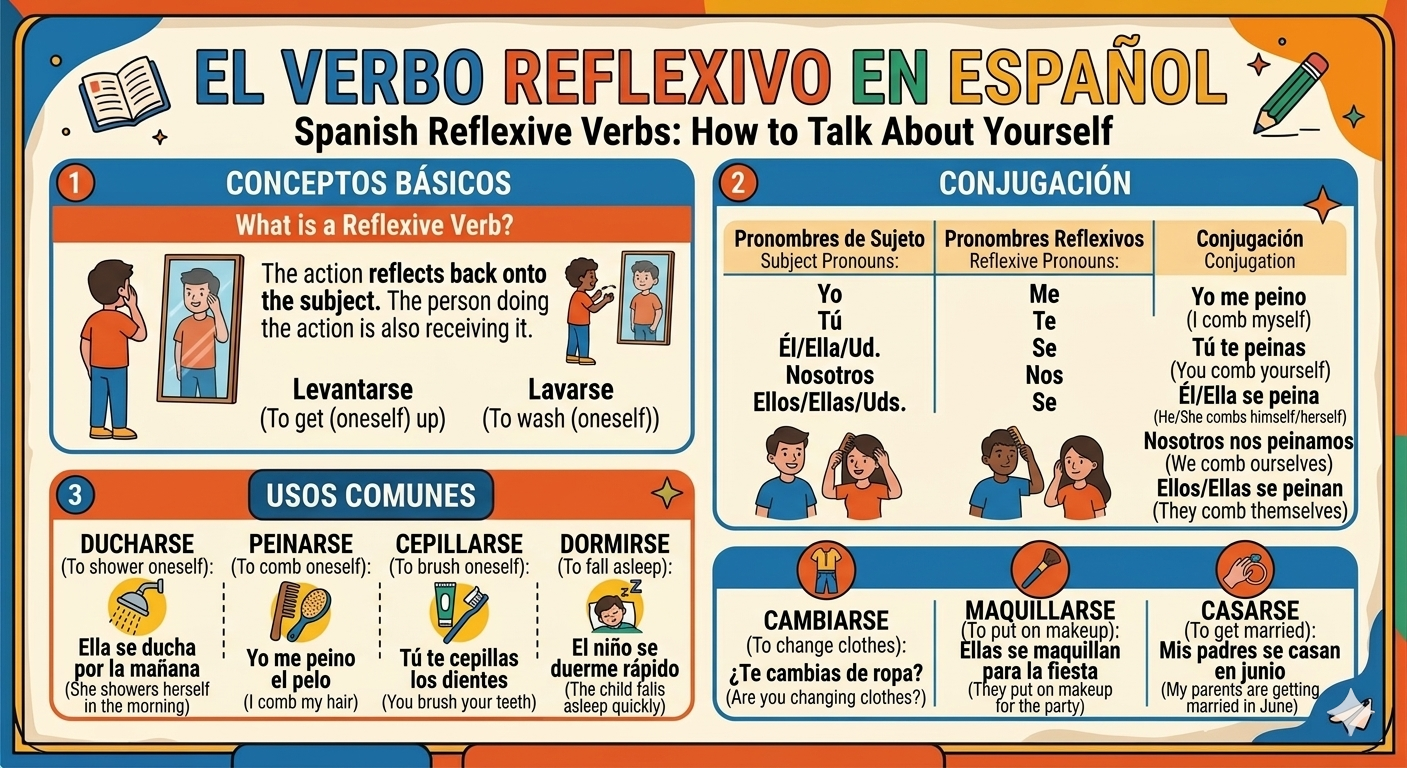
Here's the concept in one sentence: a reflexive verb is when the subject does the action to themselves.
You — doing something — to you.
In English, we express this with words like myself, yourself, himself, herself. Think:
I cut myself.
She introduced herself.
He hurt himself.
See the pattern? The action bounces back onto the person doing it. That's the reflexive idea.
Spanish does the exact same thing — but instead of adding a separate word like "myself" at the end, Spanish attaches a little pronoun before the verb. That pronoun is what you're seeing when you read all those me, te, se, nos floating around.
In English: I wash myself. In Spanish: Me lavo. — Literally: "Myself I wash."
Same idea. Different grammar order. And once that clicks, everything else in this article will make sense.
The Reflexive Pronouns: Your New Best Friends
Before we get into actual verbs, you need to meet the team. These are the reflexive pronouns in Spanish — one for each person:
Person | Reflexive Pronoun | English Equivalent |
|---|---|---|
yo (I) | me | myself |
tú (you) | te | yourself |
él / ella / usted (he / she / you formal) | se | himself / herself / yourself |
nosotros (we) | nos | ourselves |
ellos / ellas / ustedes (they / you all) | se | themselves / yourselves |
These pronouns go directly before the conjugated verb. That's their home. That's where they live.
Me ducho. — I shower. (Literally: Myself I shower.)
Te lavas. — You wash yourself.
Se llama Carlos. — His name is Carlos. (Literally: He calls himself Carlos.)
Nos despertamos tarde. — We wake up late.
Notice how the reflexive pronoun and the verb are always a team — they go together like arepas and everything else on the plate. 🫓
How to Conjugate a Reflexive Verb (It's Not as Scary as It Looks)
Reflexive verbs in Spanish are listed in the dictionary with -se attached to the end: llamarse, ducharse, despertarse, levantarse. That -se is the signal that tells you: "hey, this one is reflexive."
When you conjugate them, you do two things:
Conjugate the verb normally (like any other -ar, -er, -ir verb)
Add the matching reflexive pronoun in front
Let's take levantarse (to get up / to get oneself up) as an example:
Person | Reflexive Pronoun + Verb | Meaning |
|---|---|---|
yo | me levanto | I get up |
tú | te levantas | you get up |
él / ella | se levanta | he / she gets up |
nosotros | nos levantamos | we get up |
ellos / ustedes | se levantan | they get up |
See? The verb conjugates exactly like a normal -ar verb. You just add the pronoun in front and you're done.
One pronunciation note: When you say me levanto, you don't pause between me and levanto — it flows as one smooth phrase: meh-leh-VAN-toh. Together, like a team.
The Most Common Reflexive Verbs in Spanish (And Why They're All About Your Morning)
Here's something funny about reflexive verbs: a huge chunk of them describe your daily routine. Getting up, getting dressed, brushing your teeth, going to bed. It's like the Spanish language decided that personal hygiene was the best place to introduce this grammar concept.
And honestly? It makes sense. These are the actions you do to yourself every single day.
Here are the ones you'll use most:
⏰ Morning Routine
Verb | Meaning | Example |
|---|---|---|
despertarse | to wake up | Me despierto a las siete. — I wake up at seven. |
levantarse | to get up | Me levanto tarde los domingos. — I get up late on Sundays. |
ducharse | to shower | Me ducho por la mañana. — I shower in the morning. |
lavarse | to wash (oneself) | Me lavo la cara. — I wash my face. |
cepillarse | to brush (oneself) | Me cepillo los dientes. — I brush my teeth. |
peinarse | to comb / do one's hair | Me peino rápido. — I do my hair quickly. |
vestirse | to get dressed | Me visto en diez minutos. — I get dressed in ten minutes. |
maquillarse | to put on makeup | Me maquillo antes de salir. — I put on makeup before leaving. |
🌙 Evening Routine
Verb | Meaning | Example |
|---|---|---|
acostarse | to go to bed / lie down | Me acuesto a las once. — I go to bed at eleven. |
dormirse | to fall asleep | Me duermo viendo Netflix. — I fall asleep watching Netflix. |
desvestirse | to get undressed | Me desvisto y me relajo. — I get undressed and relax. |
💬 Everyday Life
Verb | Meaning | Example |
|---|---|---|
llamarse | to be named / to call oneself | Me llamo Ana. — My name is Ana. |
sentirse | to feel (emotionally) | Me siento bien hoy. — I feel good today. |
quedarse | to stay / remain | Me quedo en casa. — I'm staying home. |
irse | to leave / go away | Me voy a las tres. — I'm leaving at three. |
sentarse | to sit down | Me siento aquí. — I'm sitting here. |
ponerse | to put on (clothing) / to become | Me pongo el abrigo. — I put on my coat. |
quitarse | to take off (clothing) | Me quito los zapatos. — I take off my shoes. |
Wait — But English Has These Too (Sort Of)
This is the part where it gets really interesting, and where the comparison to English actually helps you feel less alone.
English does have reflexive verbs — we just don't call them that, and we don't always mark them as clearly. Sometimes we use myself / yourself / himself, like we saw. But sometimes English just... drops the reflexive meaning entirely and trusts context.
Compare:
Spanish (explicit reflexive) | English (implied or stated) |
|---|---|
Me levanto. | I get up. (not "I get myself up"— we just say "get up") |
Me ducho. | I shower. (not "I shower myself"— that sounds weird in English) |
Me visto. | I get dressed. (not "I dress myself"— unless you're teaching a toddler) |
Me llamo Ana. | My name is Ana. (not "I call myself Ana"— but that's literally what it means!) |
This is actually the trickiest part for English speakers: many Spanish reflexive verbs translate into English as completely normal verbs with no "myself" in sight. The reflexive idea is hidden inside the English phrase.
Despertarse = to wake up (not "to wake oneself up") Acostarse = to go to bed (not "to lay oneself down") Sentarse = to sit down (not "to seat oneself")
So when you're translating in your head and thinking "why is there a me here? I don't see a 'myself' in the English version" — that's why. The concept is the same. Spanish just makes it visible.
The Reflexive vs. Non-Reflexive: When the Same Verb Means Two Different Things
Okay, here's where it gets genuinely mind-bending — and also kind of brilliant.
Many Spanish verbs exist in both reflexive and non-reflexive versions, and the meaning changes depending on which one you use.
The non-reflexive version = you're doing it to someone or something else. The reflexive version = you're doing it to yourself.
Non-reflexive | Meaning | Reflexive | Meaning |
|---|---|---|---|
lavar el carro | to wash the car | lavarse | to wash oneself |
despertar al niño | to wake the child up | despertarse | to wake up (yourself) |
vestir al bebé | to dress the baby | vestirse | to get dressed (yourself) |
llamar a María | to call María | llamarse | to be named / call oneself |
dormir | to sleep | dormirse | to fall asleep |
poner la mesa | to set the table | ponerse | to put on (clothing) / to become |
My favorite example — and the one that always gets a reaction in class:
Duermo ocho horas. → I sleep eight hours. (just sleeping, totally normal) Me duermo en las reuniones. → I fall asleep in meetings. (it happens to the best of us)
The me changes the meaning from a general state to something that happens to you. You didn't plan to fall asleep in that meeting. It just... occurred. Reflexively. 😅
The Mistakes English Speakers Make Most (Don't Worry, Everyone Does These)
Let's get the awkward part out of the way. These are the three most common errors — and if you make them, you're in excellent company.
Mistake #1: Forgetting the Reflexive Pronoun Completely
This is the most common one. You know the verb, you conjugate it correctly, and then you just... forget the me.
❌ Levanto a las siete. ✅ Me levanto a las siete. — I get up at seven.
Without the me, levanto means "I lift (something)." As in, you're lifting an object. Me levanto means you're getting yourself up. The pronoun isn't optional — it's what makes the verb reflexive.
Mistake #2: Using the Wrong Pronoun for the Wrong Person
Mixing up me and se is very common, especially in third person.
❌ Ella me llama Ana. ✅ Ella se llama Ana. — Her name is Ana.
Me is only for "I/me." When you're talking about someone else, it's se. When you're talking about nosotros, it's nos. The pronoun has to match the subject — always.
Mistake #3: Putting the Pronoun in the Wrong Place
In a standard sentence, the reflexive pronoun goes before the conjugated verb. English speakers sometimes try to put it after, like the English "myself" goes at the end.
❌ Ducho me por la mañana. ✅ Me ducho por la mañana. — I shower in the morning.
(There are situations where the pronoun can attach to the end of a verb — like with infinitives and commands — but that's a next-level conversation. For now: pronoun before verb, and you're solid.)
Real-Life Reflexive Phrases You Can Use Right Now
Theory is great. But you came here to actually speak Spanish, not just understand it. So here are phrases you can pull out immediately — at a hotel, meeting someone new, or just describing your day:
Meeting People
Me llamo [your name]. ¿Cómo te llamas? — My name is [your name]. What's your name?
Me alegro de conocerte. — I'm happy to meet you. (Literally: I make myself happy to know you.)
Talking About Your Day
Me despierto temprano cuando viajo. — I wake up early when I travel.
Me quedo en un hotel cerca del centro. — I'm staying at a hotel near downtown.
Me voy mañana por la mañana. — I'm leaving tomorrow morning.
Feelings and States
Me siento un poco cansado/a hoy. — I feel a little tired today.
Me pongo nervioso/a cuando hablo español. — I get nervous when I speak Spanish. (Totally valid. We see you.)
Me siento más seguro/a cada día. — I feel more confident every day.
At a Restaurant or Hotel
Me siento aquí, ¿está bien? — I'll sit here, is that okay?
Me quedo dos noches. — I'm staying two nights.
¿Me puedo quedar un poco más? — Can I stay a little longer?
A Quick Practice: Describe Your Morning in Spanish
Don't skip this. Seriously. Close your eyes for a second and think about what you did this morning — or what you'll do tomorrow morning. Now describe it using reflexive verbs.
It might look something like this:
Me despierto a las siete. Me levanto, me ducho, y me visto. Me cepillo los dientes, me peino, y me voy al trabajo. Me siento bien cuando tengo café primero. ☕
Try writing your own version. It doesn't have to be perfect. It just has to be yours.
If you got through that exercise — even with a few pauses and some dictionary help — you just used reflexive verbs in real, connected Spanish. That's not nothing. That's actually a lot.
Why Reflexive Verbs Feel Hard (And Why They're Actually Not)
Here's the honest truth about verbos reflexivos: they feel hard because nobody explains them in a way that makes human sense.
Most textbooks introduce them with a chart, three grammar rules, and fifteen conjugation exercises. You memorize the forms, pass the quiz, and then completely blank when you try to use them in a real conversation because you learned the rules — not the why.
But the why is simple: some actions loop back to the person doing them. You wake yourself up. You dress yourself. You feel something inside yourself. Spanish just has a clear, consistent way of showing that — a little pronoun that says "hey, this one is coming back to you."
Once you feel that logic instead of just memorizing the rules, the whole thing unlocks. You stop second-guessing every me and start trusting the pattern.
And that pattern? It shows up everywhere — in songs, in telenovelas, in conversations with your Colombian Airbnb host at 8am when you're barely awake and you need to say me despierto muy tarde normalmente before she judges you for sleeping until 10.
Not that that's happened to me. (It has.)
Ready to Go Deeper? Here's Your Next Step.
You've got the concept. You've got the pronouns. You've got the most common verbs and the mistakes to avoid. Now it's time to actually hear it, practice it, and make it stick.
The full lesson on verbos reflexivos — with examples, exercises, and the kind of explanations that feel like this blog post, not like a grammar textbook — is waiting for you right here:
👉 Watch the full Reflexive Verbs lesson → A2 Module 1, Class 1
This is where the blog post becomes a real class. You'll hear the verbs spoken out loud, practice the patterns in context, and walk away feeling like verbos reflexivos are something you actually own — not something you're still guessing at.
And if you want to make sure what you learn today doesn't disappear by next week, the flashcard subscription has your back. Vocabulary, verb forms, and sentence patterns — reviewed at exactly the right intervals so your brain actually holds onto them.
👉 Get the Flashcard Subscription and learn smarter →
Because the goal isn't just to understand reflexive verbs once. It's to use them at breakfast, in meetings, with strangers, and on mornings in Colombia when someone asks how you slept and you can say — confidently, correctly, without even thinking about it:
Me dormí muy bien, gracias. 😄
Hasta la próxima, amigo. Me voy — but I'll see you in the next one. 🌿