
Ser vs Estar / To Be vs. To Be: Navigating the Spanish Identity Crisis
Ser vs Estar / To Be vs. To Be: Navigating the Spanish Identity Crisis
By a Colombian friend who wants you to actually enjoy learning Spanish
If you've ever tried to learn Spanish, you've probably hit this wall pretty early: Why does Spanish have TWO verbs for "to be"?
In English, you just say "I am," "she is," "they are" — one verb, simple, done. But in Spanish? Oh, amigo, we have ser and estar, and at first glance, they can seem like the universe's cruelest joke on English speakers.
I promise you — it's not a joke. And once it clicks, you're going to feel like you've been handed a superpower.
I grew up in Bogotá, Colombia, switching between Spanish and English my whole life, and I've helped many travelers, students, and curious souls figure out this exact thing. So think of this as your friendly Colombian coffee chat — no textbooks, no boring drills, just real talk about how to use ser and estar so you can actually use them when you're ordering arepas in Medellín or asking for directions in Cartagena.
Let's dive in.
Why Does Spanish Have Two Verbs for "To Be"? (The Big Picture)
Here's the honest answer: Spanish is more specific than English. Where English just says "to be" and leaves context to figure out the rest, Spanish forces you to be a little more precise.
Think of it this way:
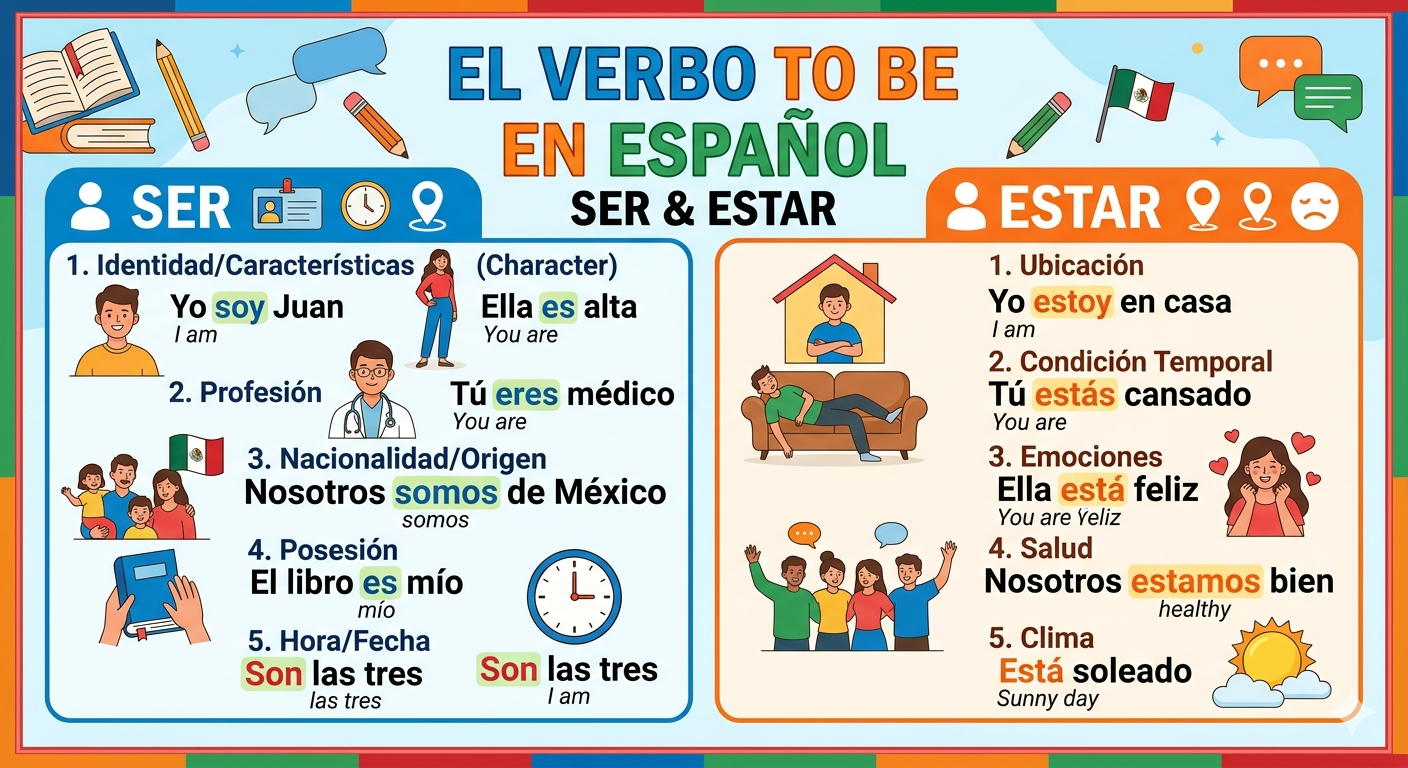
Ser (pronounced sair) is for things that are permanent or essential — your identity, origin, what something is made of, relationships.
Estar (pronounced es-TAR) is for things that are temporary or changeable — feelings, locations, conditions, states of being.
Here's a quick example to get your brain warmed up:
Soy colombiano. — I am Colombian. (That's not changing anytime soon — ser.) Estoy cansado. — I am tired. (Tired today, not tired forever — estar.)
See the logic? One is about who you are. The other is about how you are right now.
Now let's go deeper, because once you understand the "why," the "when" becomes a lot more intuitive.
When to Use SER: Your Identity and the Essentials
Think of ser as the verb for your permanent self — the stuff on your passport, your soul, your core facts.
Here's when you'll use ser:
1. Nationality and Origin
¿De dónde eres? — Where are you from? Soy de Canadá. — I'm from Canada. Ella es brasileña. — She's Brazilian.
Travel tip: When you meet locals in Colombia, Venezuela, or Mexico, they will ask you ¿De dónde eres? almost immediately. Having this answer ready in Spanish will light up their face. Try it.
2. Profession and Identity
Soy profesora. — I'm a teacher. Él es médico. — He's a doctor. Somos estudiantes. — We're students.
3. Personality Traits
Eres muy amable. — You're very kind. Mi amigo es inteligente y divertido. — My friend is smart and fun.
4. Describing What Something Is (Material, Category)
La mesa es de madera. — The table is made of wood. Este plato es típico de Colombia. — This dish is typical from Colombia.
5. Time, Dates, and Numbers
Hoy es lunes. — Today is Monday. Son las tres de la tarde. — It's three in the afternoon. La reunión es a las cinco. — The meeting is at five.
Memory trick: Think of SER as the verb for your business card — name, job, nationality, personality. The stuff that doesn't change from day to day.
When to Use ESTAR: Moods, Places, and Temporary Conditions
Estar is your "right now" verb. It's for how things are at this moment — feelings, locations, temporary states.
1. Emotions and Feelings
Estoy feliz. — I'm happy (right now). Ella está nerviosa. — She's nervous (about something today). Estamos emocionados. — We're excited.
Cultural note: In Colombia, you'll often hear ¿Cómo estás? as a greeting, which literally means "How are you?" Notice — it uses estar because feelings are temporary. When someone answers Bien, ¿y tú? ("Good, and you?"), that bien is about their current state. Very Colombian, very warm.
2. Location
This is a big one for travelers. Estar is always used for location — where something or someone is right now.
Estoy en Cartagena. — I'm in Cartagena. El restaurante está en la Plaza de Bolívar. — The restaurant is on Bolívar Square. ¿Dónde está el baño? — Where is the bathroom?
(Save that last one. You're going to need it.)
3. Health and Physical States
Estoy enfermo/a. — I'm sick. ¿Cómo estás? — How are you? El niño está dormido. — The child is asleep.
4. Temporary Conditions or Results
La puerta está abierta. — The door is open. La sopa está fría. — The soup is cold. Estoy lista. — I'm ready.
Memory trick: Think of ESTAR as a weather forecast — it tells you what's happening right now, not what things are forever.
SER vs ESTAR: Side-by-Side Comparisons (This Is Where It Gets Interesting)
Now here's where most beginner Spanish learners get a little confused — and it's actually kind of fascinating. Some adjectives change their meaning depending on whether you use ser or estar.
Let me show you:
Adjective | With SER | With ESTAR |
|---|---|---|
listo/a | He's clever (Es listo) | He's ready (Está listo) |
malo/a | He's a bad person (Es malo) | He's sick/unwell (Está malo) |
aburrido/a | He's a boring person (Es aburrido) | He's bored right now (Está aburrido) |
rico/a | She's wealthy (Es rica) | It's delicious (Está rico) |
seguro/a | It's a safe neighborhood (Es seguro) | I'm sure/certain (Estoy seguro) |
This is why context matters SO much in Spanish. And this is also why native speakers love these little nuances — they pack a lot of meaning into small words.
Quick reflection: ¿Es aburrida la gramática o está aburrida? (Is grammar boring, or is grammar bored?) 😄 Spoiler: Grammar is just waiting for the right teacher.
The Most Common Mistakes English Speakers Make with Ser and Estar
I've seen these patterns over and over, so let me save you some time and embarrassment.
Mistake #1: Using SER for Location
A very common one. English speakers often say "El banco es aquí" because they're thinking "The bank IS here." But location uses estar:
❌ El banco es aquí. ✅ El banco está aquí. — The bank is here.
Exception alert: There is one location-related situation where ser is used — when describing where an event takes place:
La fiesta es en mi casa. — The party is at my house. (The event itself) Estoy en la fiesta. — I'm at the party. (Me, physically, being there)
Mistake #2: Using ESTAR for Permanent Traits
Because estar sounds like "state," beginners sometimes want to use it for everything described in the moment. But identity-based descriptions always use ser:
❌ Estoy americano. ✅ Soy americano. — I'm American.
Mistake #3: Forgetting That Emotions Are ESTAR
This trips up a lot of beginners because in English we say "I am happy" — and that feels permanent. But in Spanish, happiness is a state you're in right now. Use estar:
❌ Soy feliz en este momento. (Only if happiness is your core identity, like a life philosophy.) ✅ Estoy feliz en este momento. — I'm happy right now.
(Though Soy una persona feliz — "I'm a happy person" — would be ser, because that's a personality trait.)
Mistake #4: The "Dead" Exception (Yes, Really)
People sometimes argue that death is pretty permanent, so it should be ser. But in Spanish:
Está muerto. — He's dead. (Using estar — it's a condition, even if it's, you know, final.)
Don't overthink it. Spanish treats death as a state rather than an identity. 🙃
Useful Spanish Travel Phrases Using Ser and Estar
This is the practical section you came for. Here are real phrases you can use on your next trip to a Spanish-speaking country — organized by situation:
At the Hotel
¿Dónde está mi habitación? — Where is my room? La habitación está sucia. — The room is dirty. ¿Está incluido el desayuno? — Is breakfast included?
At a Restaurant
Está delicioso. — It's delicious. ¿De dónde es este plato? — Where is this dish from? Estoy listo/a para pedir. — I'm ready to order. La cuenta, por favor. — The check, please. (No ser or estar needed — but still useful!)
Getting Around
¿Dónde está la estación de metro? — Where is the metro station? Estoy perdido/a. — I'm lost. ¿Está lejos? — Is it far? El aeropuerto está a veinte minutos. — The airport is twenty minutes away.
Meeting People (The Colombian Way)
¿De dónde eres? — Where are you from? Soy de [tu país]. — I'm from [your country]. Estoy viajando por Colombia. — I'm traveling through Colombia. Estoy enamorado/a de este país. — I'm in love with this country.
That last one? Say it to any Colombian and watch their heart melt. 🇨🇴
Emergencies
Estoy enfermo/a. — I'm sick. Necesito ayuda. Estoy perdido/a. — I need help. I'm lost. ¿Dónde está el hospital más cercano? — Where is the nearest hospital?
A Note on Pronunciation (Because It Matters)
Quick pronunciation guide so you don't feel awkward saying these:
Ser — sounds like "sair" (rhymes with "care")
Estar — sounds like "es-TAR" (stress on the second syllable)
When conjugating:
Pronoun | Ser | Estar |
|---|---|---|
yo (I) | soy | estoy |
tú (you) | eres | estás |
él/ella (he/she) | es | está |
nosotros (we) | somos | estamos |
ellos/ellas (they) | son | están |
Practice saying Estoy muy bien, gracias out loud right now. Seriously, do it. es-TOY moo-EE BYEHN, GRA-syas. That's "I'm very well, thank you." And you'll use it every single day in a Spanish-speaking country.
The Colombian Way of Thinking About This
Here's something I want to leave you with, because I think it's the most useful mindset shift:
In English, "to be" is a single, blunt tool. In Spanish, ser and estar are like having a scalpel and a paintbrush — two different instruments for two different kinds of truth.
Ser says: This is what I am. This is my essence. Estar says: This is where I am. This is how I feel today.
When I was growing up in Bogotá and translating back and forth between both languages, I started to see Spanish as more emotionally honest in this way. It makes you acknowledge that your tiredness is temporary, that your happiness is something you're experiencing right now, that your nationality is part of your identity — not just a fact you happen to have.
There's a reason Colombians greet each other with ¿Cómo estás? instead of ¿Cómo eres? We want to know how you're doing today, in this moment. How are you feeling right now? That's what matters.
And that's the heart of estar.
You're Not Just Learning Grammar — You're Learning a Culture
Every time you choose between ser and estar, you're not just filling in a grammar slot — you're deciding what kind of truth you're telling.
That's not a burden. That's actually kind of beautiful.
Here's the thing about learning Spanish that nobody tells you at the beginning: the grammar makes sense culturally. The more you understand the people behind the language — their rhythms, their values, their way of seeing the world — the more the grammar stops feeling like rules and starts feeling like logic.
And Latin America? Oh, it's the most generous classroom you'll ever find. From the warmth of a Caleña street conversation to the patience of a Bogotá café owner who's happy to repeat themselves twice if you ask — Spanish speakers want you to learn. They celebrate every attempt.
So go ahead. Make mistakes. Say Soy aquí when you mean Estoy aquí. Someone will gently correct you and probably laugh with you (not at you), and you'll never make that mistake again.
That's how real language learning happens.
Keep Going: Your Next Step in Learning Spanish
You've made it this far, which tells me something important: you're serious about this. And you deserve more than a single blog post.
If this felt like a good start — clear, human, actually useful — then I want to invite you to continue this journey with structured lessons built exactly this way: warm, practical, culturally rich, and designed for real travelers and curious minds who want to speak Spanish for real life.
👉 [Explore the full beginner Spanish lessons on the website] — Each lesson builds naturally on the last, and every one comes with travel scenarios, Latin American cultural context, and the kind of explanations that actually stick.
Not sure where to start or which level you're at?
👉 [Take the free Spanish placement test] — It takes about 5 minutes and will tell you exactly where to begin so you're not wasting time on things you already know or drowning in things you're not ready for yet.
Whether you're planning a trip to Colombia, heading to Mexico City for the first time, or just falling in love with the sound of Spanish from your living room — you belong here.
Hasta pronto, amigo/a. You've got this. 🌿